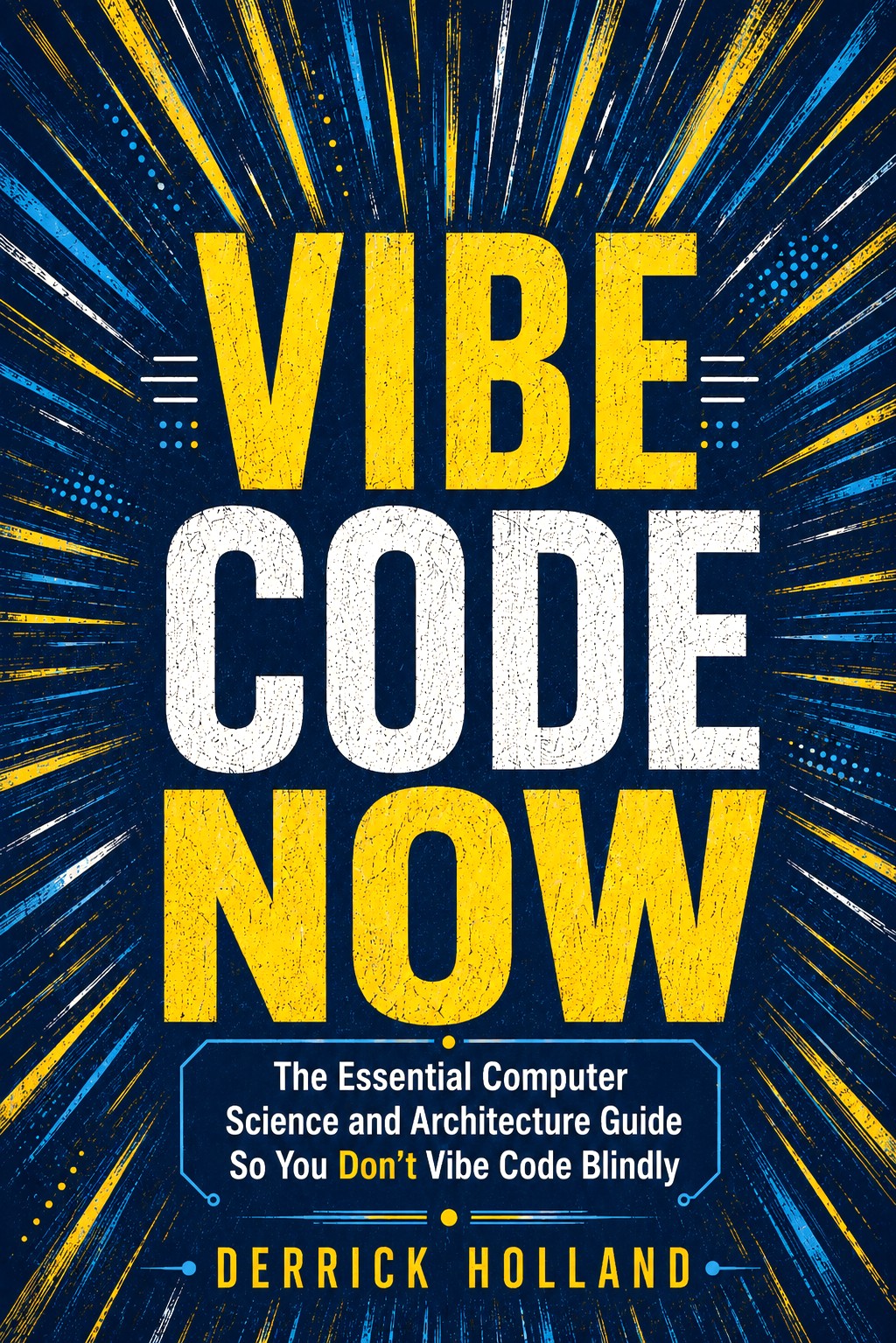
Vibe Code Now: The Essential Computer Science and Architecture Guide
Let the agent type. You stay in control.
The agent can write the code. You still own the consequences.
AI makes software creation radically more accessible, but accessibility is not the same as safety. This field guide gives nontraditional builders the foundations to review decisions, protect systems and recognize when apparent success is not enough.
Protect credentials and production
Review code you did not write
Know when to keep a human gate
How the visual identity supports the book’s argument.
Four ways this book changes how you understand the subject.
Know what the agent controls
Understand the files, commands, credentials, databases and infrastructure an AI coding tool can affect.
Catch expensive mistakes earlier
Recognize security, data-loss, concurrency and cost risks before they reach production.
Review work with evidence
Use diffs, tests, logs and monitoring even when you could not have written every generated line yourself.
Ship with a recovery plan
Use Git, staging, backups, limits and human approval gates so a mistake does not become irreversible.
A closer look
Vibe Code Now --- The Missing Manual for AI-Assisted Software Development
Vibe coding changes how software is built. A person can now launch a website, mobile app, SaaS product, automation, internal tool, or AI-powered service without following the traditional path into programming.
But skipping that path can also mean skipping the knowledge that once protected builders from dangerous commands, exposed credentials, unreliable systems, insecure databases, irreversible migrations, and production failures.
Vibe Code Now gives you that missing knowledge in one practical, accessible guide. It focuses on what matters when an AI agent is doing the typing but you are still responsible for the result.
If you read only one book about building software with AI, make it this one.
It will help you understand what your agent is doing, ask the questions that expose hidden risks, recognise when apparent success is not enough, and know when the consequences are too serious to proceed on confidence alone.
Everything a Vibe Coder Needs to Know
This is not a traditional programming textbook. You will not be asked to memorise algorithms, master a programming language, or write every component from scratch. Instead, you will learn the practical concepts that help prevent the most expensive mistakes AI-assisted builders make.
From your first prompt to a live production system, this book explains what the agent is actually controlling, what can go wrong, how to verify its work, and when you should refuse to let it proceed without human review.
Inside, You'll Learn How To:
- Protect API keys, passwords, access tokens, environment variables, and production credentials
- Decide what an AI coding agent may read, modify, execute, publish, or delete
- Choose safely between local execution, containers, sandboxes, cloud environments, staging, and production
- Use Git, branches, commits, diffs, backups, and rollbacks as practical safety systems
- Understand how code actually runs through processors, memory, processes, runtimes, and operating systems
- Make sense of filesystems, networking, APIs, databases, caches, queues, and background jobs
- Recognise race conditions, duplicated operations, unsafe retries, and concurrency failures
- Review AI-generated code even when you could not have written every line yourself
- Identify authentication, authorisation, injection, privacy, logging, and dependency risks
- Make sensible software-architecture decisions without creating unnecessary complexity
- Test, debug, monitor, deploy, and recover software more safely
- Prevent runaway infrastructure, API, database, storage, and AI-service costs
- Know what to delegate to an agent, and what must remain behind a human approval gate
For founders, creators and AI-assisted developers who can build quickly—and want their software to survive contact with reality.
The missing manual for AI builders