Why “Made in Germany” Is Not Selling Anymore?
When reputation is no longer enough.
Engineering excellence is a foundation—not a strategy.
Germany’s industrial reputation was built over generations. This book examines why that reputation stopped guaranteeing sales, where competitors moved faster, and what renewal could look like without abandoning the strengths that made German manufacturing admired.
28% export decline since 2016
The lost decade of transformation
Can an industrial icon reinvent itself?
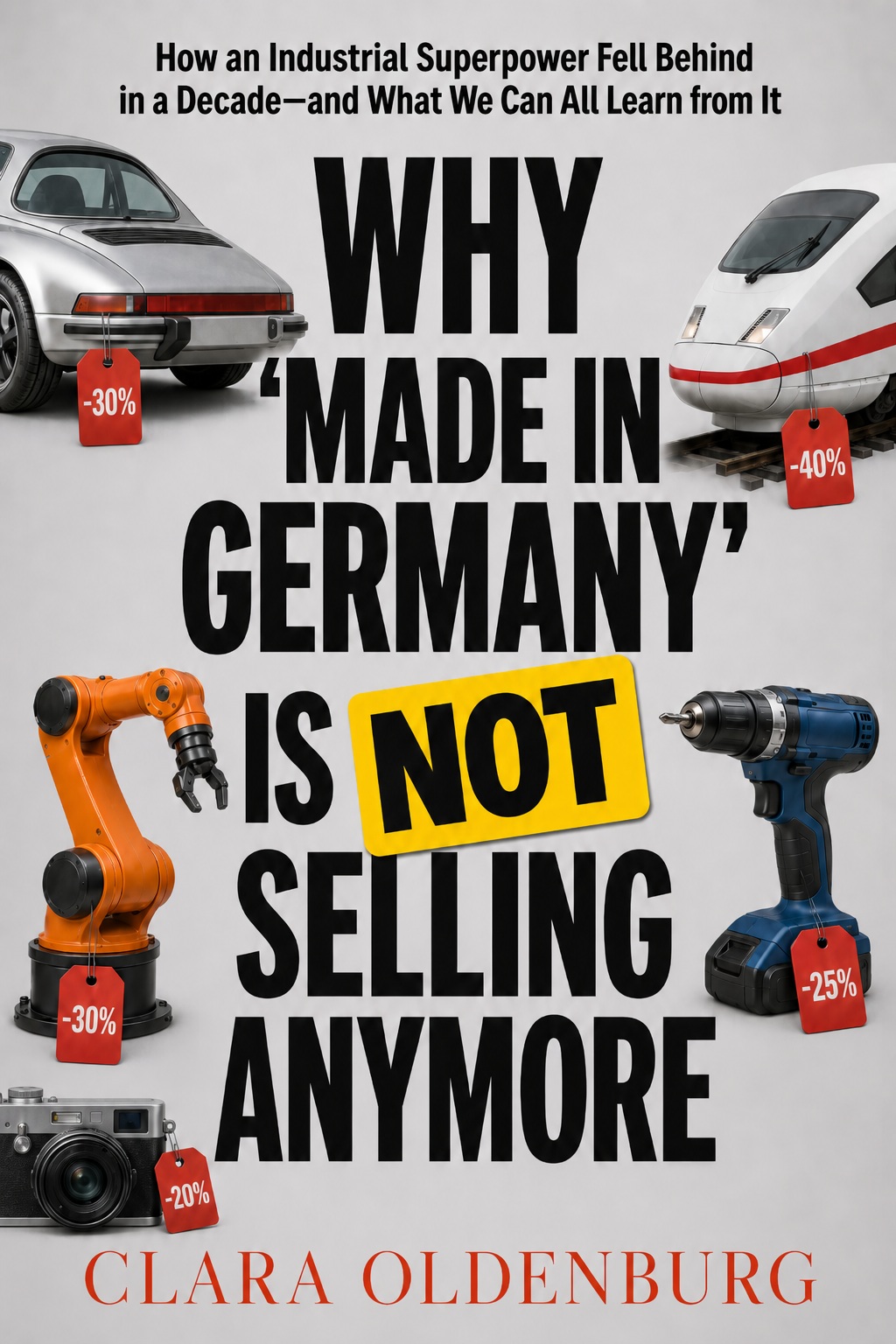
How the visual identity supports the book’s argument.
Four ways this book changes how you understand the subject.
Look beyond the reputation
Understand why engineering quality and a famous national brand no longer guarantee that customers will buy.
Identify the real causes
Connect the EV transition, energy costs, bureaucracy, infrastructure and investment gaps instead of blaming one convenient factor.
Learn from faster competitors
See how rivals changed price, software, speed and customer expectations while German industry defended its old advantages.
Judge the recovery choices
Evaluate what Germany should preserve, what it must change and which proposed solutions are likely to matter.
A closer look
Why is “Made in Germany” no longer selling?
German passenger-car exports have fallen sharply since 2016. After two consecutive years of recession, Europe’s industrial engine is slowing down.
Why “Made in Germany” Is Not Selling Anymore? reveals how a manufacturing superpower lost the decade that transformed the global economy. Products remained expensive without remaining sufficiently better. Executives protected yesterday’s profits. Banks financed the past. Politicians announced transformations that the country’s infrastructure could not deliver.
Germany still exports more than €1.5 trillion in goods a year. That is what makes the danger easy to miss. Decline rarely begins with empty factories. It begins when impressive totals conceal vanishing advantages.
This book investigates what Germany lost, what it still possesses, and whether one of history’s most successful industrial economies can reinvent itself before reputation becomes the most valuable part of a product nobody wants.
This is a book for readers interested in:
- German economic decline and industrial competitiveness
- Cars, electric vehicles, batteries and automotive software
- Global manufacturing and technological competition
- Artificial intelligence, semiconductors and digital platforms
- Trade, exports, supply chains and deglobalization
- The euro, the ECB, banks and European finance
- Energy prices, nuclear power and the green transition
- The Mittelstand, unions, strikes, wages and productivity
- Bureaucracy, infrastructure and industrial policy
- Why powerful economies fail — and whether they can recover